

Chyma & The Toll of Time
Engine: Unity
Development Timeline: August 2025-April 2026
Team Size: 15
Roll: Product Owner & Narrative Designer
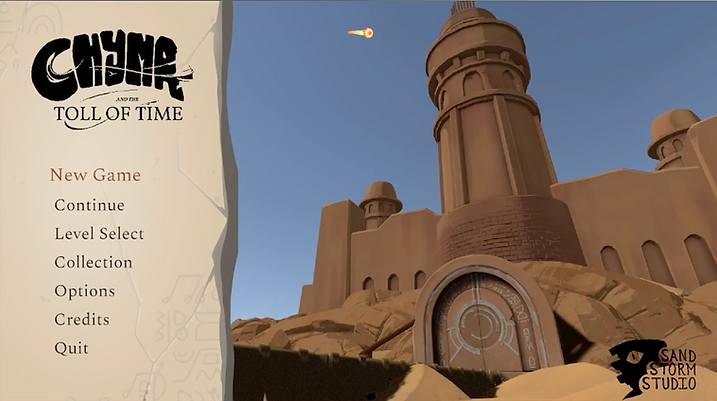
Chyma and the Toll of Time is an isometric 3D puzzle platformer where you play as a young bell (Chyma) who is taught the ‘Toll of Time’, an ancient song, by the Temple of Carillon. This lets him be in two places at once, an ability that aids in his journey to learn more about what has happened in this place and stop the threat of an impending meteor.
This is the Train station, one of the areas of the game that I proposed. Narratively, this is where bells of Carillon would go when entering and exiting the Temple. There were also rails to other parts of the Temple, allowing for quick travel
Project Description
Intent
As a team of developers, we knew that we wanted to create a calm, comfortable game while still including aspects of curiosity and a narrative that felt organic and interesting.
Game Play Description
In Chyma and the Toll of Time, you play as Chyma, a bell that has been granted the ability to record and play their ‘Reverb’, a version of themselves that does all the actions Chyma did while recording. Chyma must use this ability to traverse the temple puzzles, avoid enemies, and find artifacts.
My Contribution to this Project
Context Design
As Product Owner, a lot of what I did on this project was listening to what other people on the team wanted, and finding a way to craft it into a bigger picture that felt cohesive and well-thought-out. The main core of that was figuring out how to contextualize things in a way that would appease all 5 disciplines. In the early stages of the project, it became clear that the members of the team wanted to have a dynamic sound system. This was being discussed around the same time the lead artist decided on a bell-based design for the main character. That's when I made the connection between these two wants, proposing that the magic in the game be contextualized as “sound can manipulate sand (the main material in our setting)”. This helped us flavor all of the mechanics in our game, and in later production, it aided in creating new, unique mechanics that were built around this contextualization.
Product Ownership
Product ownership also meant overlooking and steering each discipline in the direction of the bigger picture. Each week of alpha & beta development, I reviewed and wrote down a critique and review of all sound, art, and design deliverables that had been made since my last review. This process allowed for a steady stream of information and feedback, opening the door to a culture of quick iteration and thoughtful introspection. It also allowed me to make suggestions for the betterment of the product. For example, early in development, I noticed that the sounds in the game, being electronic, created a “sci-fi” feel, but the art direction was more of an “ancient fantasy”. I suggested shifting the sounds from electronic keyboard to more traditional percussion, woodwind, string, and brass instruments to create a sonic direction that felt grounded and whimsical, enhancing the fantastical visuals.
Game Story and Progression
Once our proof of concept passed, the question of the bigger picture was in my lap, and it was my job to figure out an overall game/story progression that met our intended player experience, as well as build on the strengths of all 15 members. I ended up pitching a game story/progression map formatted according to a typical story structure to plot the way progression is handled. The most natural conclusion was to introduce the idea of progression gates. The team had already been playing around with the idea of multiple distinct areas, which made it easier to place progression gates on the map.
This improved player experience by giving the player more immediate goals to keep them invested in the gameplay. It also enhanced the world-building by having distinct areas filled with props the player would associate with real-world spaces, giving artists a chance to show off environmental skills and ensuring mechanics would be spread out in a digestible way
This game progression plan became an integral reference for iteration and building upon our foundation from our proof of concept, and was built into all the documentation that we made to help us progress towards the player experience we wanted to create.
Artifacts
The artifacts in this game are how the player learns information about the current threat and the way this world works, but it is also how the character of "Carillon" is grown. Carillon is the civilization that created the temple and the "Toll of Time", but they are now gone, leaving behind only ruins. Chyma, who finds out he is a descendant of Carillon through these artifacts, must use what he learns here to save the world, but as he learns more about the world, he gradually makes the decision to rebuild this place.
This character arc isn't satisfying if player-character immersion isn't reached, so when creating these artifacts, I tried to replicate them from cultural aspects we have in our world. News articles, murals, statues, magazines, and structures all tell the story of Carillon, highlighting how it struggled with the creation of the Toll of Time and how it gradually adapted over time to incorporate it into everyday life. This all works to draw similarities between Carillon and our own culture, a personal connection that creates a desire to save this place in the player.
Cutscenes
There are two cutscenes in Chyma that aid in contextualizing what is happening at the start and end of the game for the player. The first cutscene sets up Chyma finding the Temple, and the last cutscene provides a satisfying conclusion to the story after the player beats the hardest levels.
To create these cutscenes, I worked closely with our lead artist and animator. I created a written-out storyboard, going over each shot, what it was meant to convey, and what the most important aspects of it were. We cut it down to the animator's scope, and I looked over the animation process closely to ensure they were conveying the story properly
What I Learned
I learned so much about leadership on this project, mainly how to recognize the wants and needs of a group of people working together to create something, and to find common ground among those wants to see the bigger vision of what the game should be. Being a leader requires a really deep understanding of every person's viewpoint, thinking about it critically while also being empathetic, and this project pushed me to harness that skill.


This is the Library, another area of the temple that I proposed. Narratively, this is where all of the knowledge and history was kept. Bells could visit it freely. Now it is falling apart due to the movement of time, but greenery still manages to peak through 500 years later
This is the Forge, another area of the temple that I proposed. Narratively, this is where bells and other brass objects were made. It is eerily cold here, as frozen lava and undead bells act as a reminder of the ways this place was abandon. It also drives the question of "what happened here?"
This is the first piece of documentation for the plot map. This map was built into so many other pieces of documentation throughout the project.
This is a tablet that goes over how you can use the toll of time to “clean your bell”, supposed to remind the player of magazine beauty hacks. This builds culture as a character to make the player care more about this place
Shot from the ending cutscene, but you will have to play the game to see the full thing in action.
